How to Reduce False Alarms in AI Forklift Pedestrian Detection
Read More

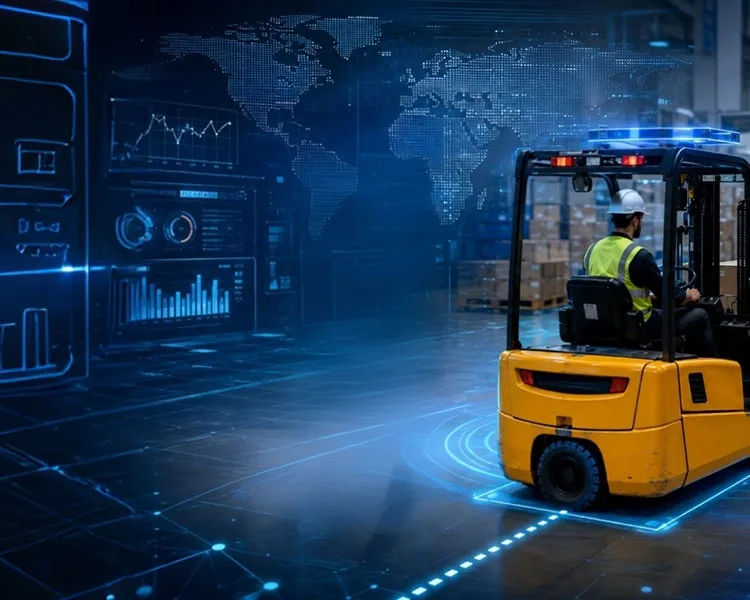
A forklift is approaching a warehouse intersection when a pedestrian unexpectedly enters its travel path. The operator receives an audible warning, but recognizing the danger and reacting to it takes time. If the vehicle continues moving at the same speed, that delay may leave insufficient distance to avoid a collision.
An automatic slowdown system adds another response to this situation. Instead of relying entirely on the operator to reduce speed, the collision avoidance system can send a control request to the forklift when a defined danger condition is detected.
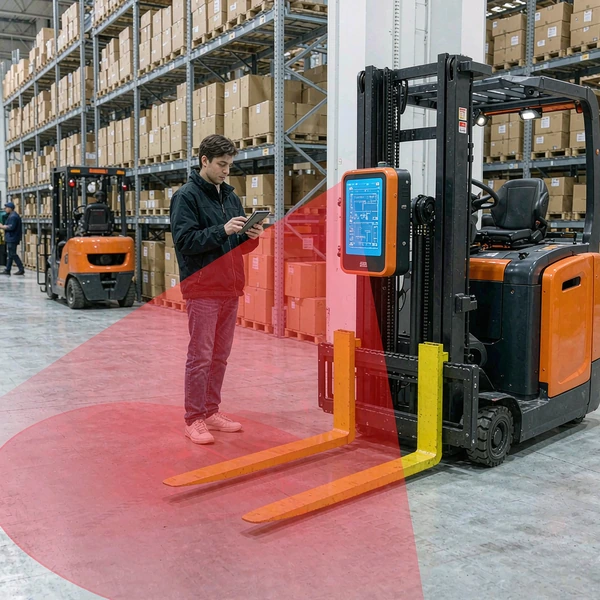
But how does information from a camera or sensor actually cause a forklift to slow down? The answer lies in the connection between hazard detection, risk assessment, safety control logic, and the vehicle's own drive or braking system.
Automatic forklift slowdown works through a sequence of hazard detection, risk assessment, control requests, and vehicle response. When a pedestrian or obstacle meets a configured danger condition, the collision avoidance controller requests a speed reduction through a compatible forklift interface. Depending on the integration, the vehicle may limit travel speed, reduce drive output, or apply an approved braking function.
An active forklift collision avoidance system does more than identify objects near a moving vehicle. It connects the information collected by cameras or sensors to a decision about whether the forklift needs to warn the operator, reduce speed, or stop.
The process involves four connected functions:
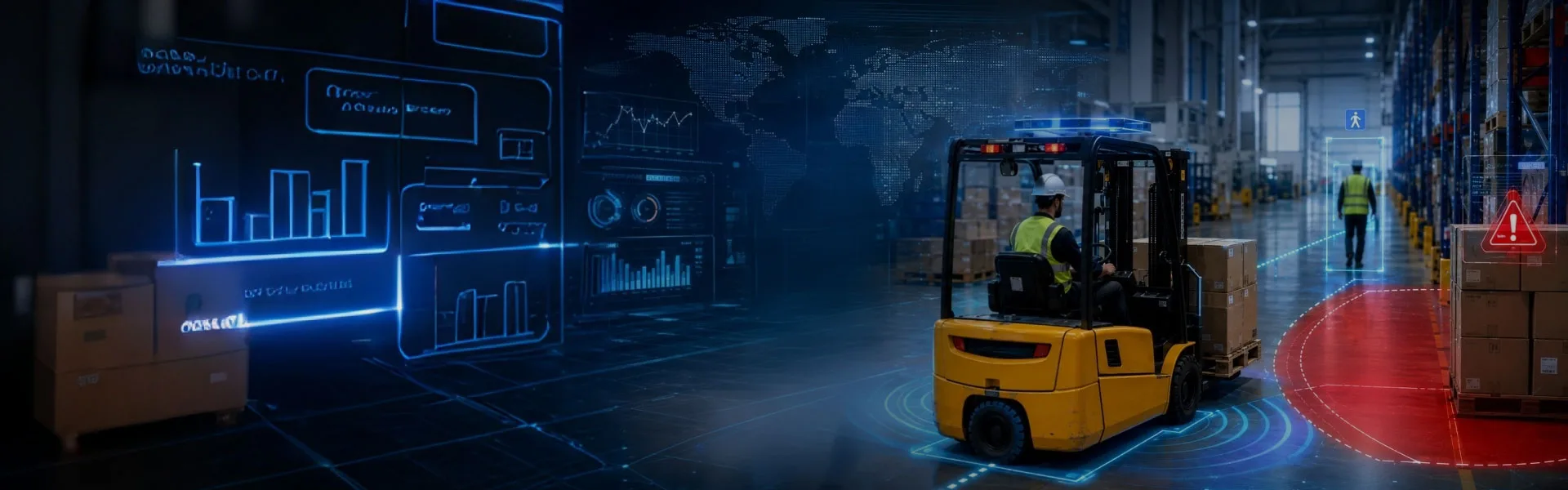
Detection → Risk Assessment → Control Request → Vehicle Response
Although different manufacturers use different hardware and software architectures, this sequence explains the basic relationship between recognizing a hazard and controlling forklift movement.
The process begins when the system detects a pedestrian, vehicle, or other relevant obstacle within its monitored area.
An AI-based system may use cameras to distinguish pedestrians from surrounding warehouse objects. Other collision detection technologies use radar, UWB, or additional sensors to identify proximity or movement-related risks.
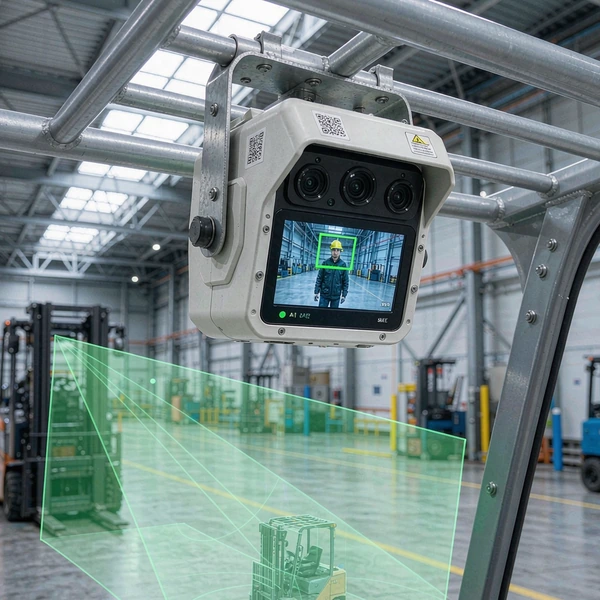
What matters is the information passed to the next stage. A detection result may identify the type of target, its location within the monitored area, or its distance from the forklift, depending on the technology.
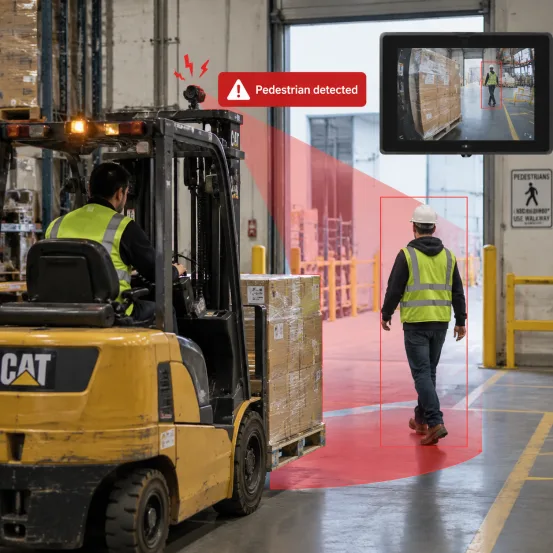
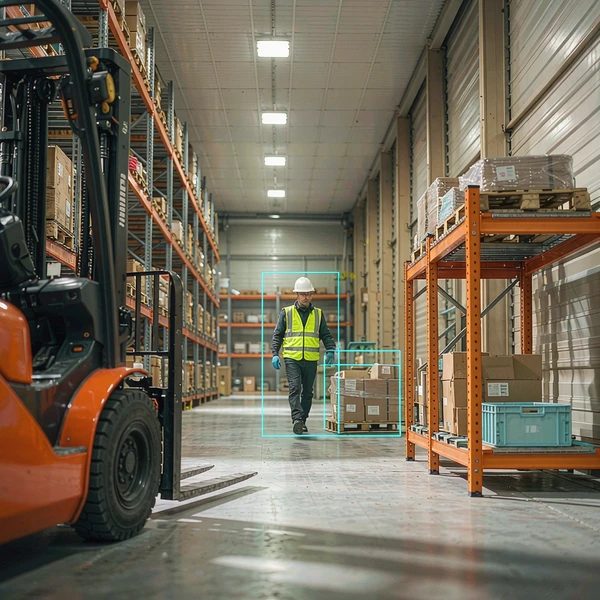
For example, an AI camera installed on a forklift may recognize a pedestrian approaching from the front and transmit that detection to a safety controller.
However, identifying the pedestrian does not automatically mean that the forklift should stop. The system must first determine whether the detected situation meets the configured conditions for intervention.
After detecting a target, the controller evaluates the available information against its configured safety logic.
A basic system may use predefined warning and danger zones. If a pedestrian enters the outer monitored area, the controller may issue an early warning. If the pedestrian reaches a more critical zone, the system may request a stronger warning or vehicle intervention.
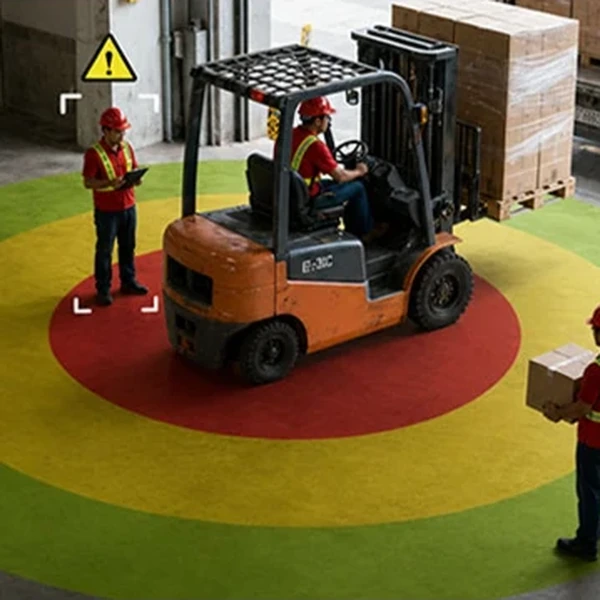
More advanced systems may also consider available information about vehicle speed, travel direction, or the position of the detected target.
This distinction is important at warehouse intersections. A pedestrian standing beside a designated walkway may not present the same immediate risk as someone entering the forklift's travel path.
The controller's task is to apply the system's defined intervention logic to the detected situation. Its effectiveness depends on the information the system can measure and how the risk conditions have been configured.
Once an intervention condition is met, the safety controller sends a request through the installed vehicle-control interface.
This is the point where an active collision avoidance system differs from a camera-only warning device.
A warning-only system alerts the operator, who must decide how to respond. An active system can additionally request a speed reduction or braking action through compatible vehicle controls.
The controller may communicate with an existing speed-control input, a suitable traction-control interface, or an approved braking-control arrangement.
The exact method depends on the forklift's electrical and control architecture.
A detection system cannot automatically slow every forklift simply because it identifies a pedestrian. The requested action must be supported by the vehicle and implemented through an appropriate interface.
The final stage is the forklift's physical response.
The vehicle receives the requested action and implements it through its supported control functions. This may involve limiting the permitted travel speed, reducing drive output, or activating a compatible braking function.
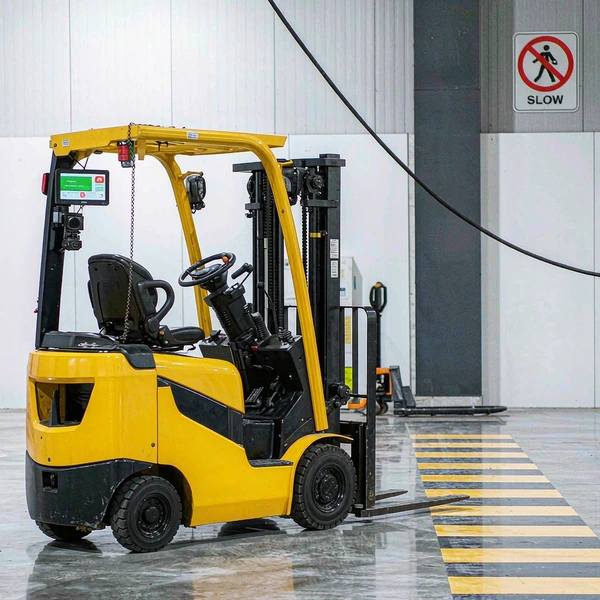
The resulting deceleration depends on the control method and operating conditions.
A forklift carrying a heavy load may respond differently from an unloaded forklift. Vehicle speed, floor traction, load stability, and the available stopping distance also influence the result.
This is why the complete detection-to-intervention chain must be validated on the actual vehicle. A successful pedestrian detection does not, by itself, prove that the forklift will achieve the intended slowdown or stopping performance.
Automatic slowdown is often described as a single feature, but several vehicle-control methods can produce a reduction in travel speed.
Understanding these differences helps buyers determine whether a proposed system provides simple speed limitation, controlled deceleration, or active braking.
A forklift speed control system may restrict travel speed by changing the permitted speed command or interacting with a supported traction-control function.
Some forklifts provide a reduced-speed operating mode that can be activated through an approved input. Others may require a dedicated control module compatible with the vehicle's electronic control system.
When a collision avoidance controller requests this function, the forklift can be prevented from continuing at its previous permitted speed.
However, speed limiting does not necessarily produce immediate stopping. Depending on the vehicle, the response may involve reducing drive output and allowing the forklift to decelerate according to its normal control behavior.
This approach can be useful when the objective is to reduce vehicle speed as a pedestrian approaches a defined risk area.
Active braking goes beyond setting a lower speed limit.
In this arrangement, a compatible vehicle-control system receives a braking request when a defined danger condition is reached.
The braking function must be properly integrated with the forklift's existing controls. Depending on the vehicle architecture, this may involve an electronically controlled braking function or another manufacturer-approved arrangement.
A loaded forklift must not be treated like a passenger car. Abrupt deceleration can affect load stability and vehicle handling, particularly when turning or operating on an uneven or low-traction surface.
Therefore, a controlled stopping strategy must consider how the forklift behaves under its intended operating conditions.
The distinction can be summarized as follows:
| Vehicle response | How it works | Main limitation |
| Driver warning | Alerts the operator through sound, light, or display information | Driver action is required |
| Automatic speed limiting | Requests a lower permitted vehicle speed | Does not necessarily stop the forklift |
| Drive-output reduction | Reduces the available traction or acceleration command | Actual deceleration depends on vehicle behavior |
| Active braking | Requests braking through a compatible vehicle-control function | Requires suitable integration and validation |
When comparing equipment, buyers should ask which of these functions the supplier actually provides rather than relying only on the term "automatic slowdown."
The decision to intervene should reflect the actual hazard, not simply the presence of an object somewhere near the forklift.
Consider two situations. In the first, the vehicle travels parallel to a storage rack with no pedestrian entering its route. In the second, a worker unexpectedly crosses directly ahead of the moving truck.
Both situations involve nearby objects or people, but they do not necessarily require the same response.
A stationary rack beside a normal travel route should not automatically be treated as presenting the same hazard as a pedestrian entering the forklift's path.
However, the actual response depends on the detection technology and the controller's configured intervention rules.
An AI pedestrian detection system may distinguish people from non-human objects. A radar-based or general obstacle detection system may also monitor stationary structures, depending on its purpose and configuration.
This means a fixed rack may be ignored by one pedestrian-focused system while triggering an obstacle warning in another system designed to monitor nearby structures.
The important question is not whether a system detects racks, but whether its intervention logic responds appropriately to the objects and risks it is designed to monitor.
During a site trial, buyers should observe vehicle behavior when traveling alongside normal warehouse structures and when pedestrians enter designated hazard areas.
The system should be evaluated against its intended detection functions and approved risk conditions, rather than expecting every nearby object to produce the same slowdown response.
A warning threshold and a vehicle-intervention threshold do not necessarily serve the same purpose.
An early warning may notify the operator when a pedestrian enters a monitored area. Automatic slowdown may require a separate condition indicating greater risk.
For example, a system with configurable risk zones might use the following sequence:
| Risk condition | Possible system response |
| Pedestrian enters an outer monitored area | Early visual or audible warning |
| Pedestrian reaches a higher-risk area | More urgent warning and speed-control request |
| A defined critical intervention condition is reached | Braking request, if supported by the installed vehicle configuration |
This is an illustrative control sequence, not a universal operating rule or a statement of fixed WTSAFE thresholds.
The distance or condition used to trigger each action must be selected according to the equipment's capabilities and a site-specific risk assessment.
Simply moving the slowdown threshold closer to the forklift may reduce unwanted interventions, but it can also leave less distance for the vehicle to respond.
The correct threshold is not the one that produces the fewest warnings. It is the one that provides an appropriate response to the defined risk while accounting for the forklift's stopping capability.
Automatic intervention cannot be separated from the distance a moving forklift needs to slow down.
At 6 km/h, a forklift travels approximately 1.67 meters per second. If one second passes before effective deceleration begins, the truck has already moved about 1.67 meters, excluding the additional distance required to reduce speed or stop.
This example illustrates the importance of response time; it is not a specified stopping distance for a forklift.
Actual stopping performance depends on the vehicle, load, floor conditions, braking system, and operating speed.
OSHA's guidance on forklift operating speed emphasizes the importance of load characteristics, pedestrian traffic, surface conditions, and adequate stopping distance.
For active collision avoidance, these factors help explain why detection distance, warning thresholds, and vehicle-control response must be evaluated together.
Retrofitting an automatic slowdown system is possible on some existing forklifts, but the feasibility depends on the vehicle's control architecture.
For example, an electric forklift with a compatible electronic traction controller may provide a suitable interface for requesting reduced travel speed. An older internal-combustion forklift may require a different integration method or may not support the proposed function.
Even forklifts from the same manufacturer can use different controllers across models and production years.
This makes vehicle compatibility one of the most important questions for distributors and system integrators.
A supplier needs to establish not only whether cameras and warning devices can be installed, but also whether an approved control connection can be made to the forklift.
Relevant technical information includes the vehicle make and model, controller configuration, available electrical interfaces, intended intervention method, and any applicable manufacturer restrictions.
The difference between a warning-only retrofit and an active slowdown retrofit can therefore be substantial.
A camera and warning display may operate independently from the vehicle's traction system. Active speed intervention requires an additional integration path that can safely influence vehicle movement.
For mixed-brand fleets, it may be necessary to evaluate several representative forklift configurations before deciding on a deployment plan.
A failure in the detection or control chain introduces an additional safety concern.
For example, a camera may lose its detection function, a communication connection may be interrupted, or a vehicle-control interface may stop responding.
The system's fault response depends on its safety architecture.
Possible responses include diagnostic warnings, disabling an affected function, or another predefined protective action. However, no universal failure response should be assumed.
In particular, buyers should not assume that every sensor fault automatically causes a forklift to stop. An unexpected stop may itself create risks, especially during load handling or in busy traffic areas.
The correct behavior must be defined through the approved safety design and vehicle integration.
Before commissioning, installers should confirm how relevant faults are detected, indicated, and handled, and how the system returns to normal operation after the problem has been resolved.
The WTSAFE SF-420 Pro AI Forklift Collision Avoidance System combines AI-based hazard detection with driver warnings and vehicle speed intervention functions.
Rather than stopping at pedestrian recognition, the system is designed to connect detected danger conditions with appropriate vehicle responses. Its AI cameras provide hazard detection information, while the controller supports audio-visual warnings and speed-control or braking functions through compatible vehicle integration.
The important distinction is the link between detection and vehicle control: the system can move beyond notifying the operator to requesting an active response when a configured intervention condition is reached.
This makes the SF-420 Pro relevant for forklift dealers, system integrators, and warehouse operators evaluating collision avoidance equipment with automatic slowdown capabilities. The available intervention functions and implementation method should be confirmed for the intended forklift model.
Before automatic slowdown is activated across an operating fleet, a controlled trial should confirm that the detection system, intervention logic, and forklift controls respond as intended.
The evaluation should establish when a pedestrian or obstacle is detected, which condition triggers a warning, when a slowdown request is issued, and how the vehicle responds.
It should also distinguish between a commanded speed reduction and actual vehicle deceleration. A controller may issue the correct request, but the resulting movement depends on the forklift's control system and operating conditions.
For a meaningful assessment, the test plan should cover the relevant vehicle configurations, operating speeds, load conditions, and site environments.
Where appropriate, engineers should verify the response at normal warehouse structures, designated pedestrian crossings, and controlled hazard scenarios. Fault detection and communication loss should also be included according to the system's approved commissioning procedures.
Tests involving pedestrian proximity must be conducted using appropriate safeguards. Personnel should not be deliberately placed in the travel path of a moving forklift to demonstrate automatic stopping.
The final assessment should answer three practical questions:
Does the system recognize the intended hazard and apply the correct intervention condition?
Does the forklift respond as specified under the tested operating conditions?
Can the installation maintain the required safety behavior during normal operation and relevant faults?
A successful trial on one forklift is useful evidence, but it does not automatically establish identical performance across different vehicle models.
Possibly. The key requirement is a suitable vehicle-control interface, not simply the age of the forklift. Older vehicles may require different integration arrangements, and some may support warning functions without an approved method for active speed intervention.
In this context, traction or drive control can limit the available drive command or permitted travel speed, while automatic braking requests a braking action through a compatible vehicle function. Both may reduce speed, but they rely on different control mechanisms and can produce different vehicle responses.
Some systems support controlled stopping on compatible vehicles. Whether the function is appropriate for a loaded forklift depends on the vehicle's braking system, load stability, operating conditions, and approved integration. Stopping performance must be validated rather than assumed.
Active speed intervention requires a suitable connection to a vehicle-control function. The interface may involve the existing traction controller, a supported reduced-speed input, or another approved control arrangement. A camera-only installation cannot automatically control vehicle speed without such integration.
Not necessarily. Pedestrian detection may trigger an early warning, while automatic slowdown or braking may require a separate danger condition. The response depends on the system's configured control logic and available vehicle-intervention functions.
An automatic slowdown system must do more than detect a nearby hazard. It must identify when intervention is necessary, communicate the correct control request, and produce a predictable vehicle response.
For forklift buyers and system integrators, the most important questions concern the vehicle-control interface, the difference between speed limiting and active braking, and whether the complete detection-to-intervention process has been validated on the intended forklift.
Contact WTSAFE with your forklift make and model, controller information if available, operating environment, and required slowdown or stopping functions. Our team can help you review the SF-420 Pro's suitability and the technical requirements for your application.