How AI Cameras Help Monitor Forklift-Pedestrian Near Misses
Read More

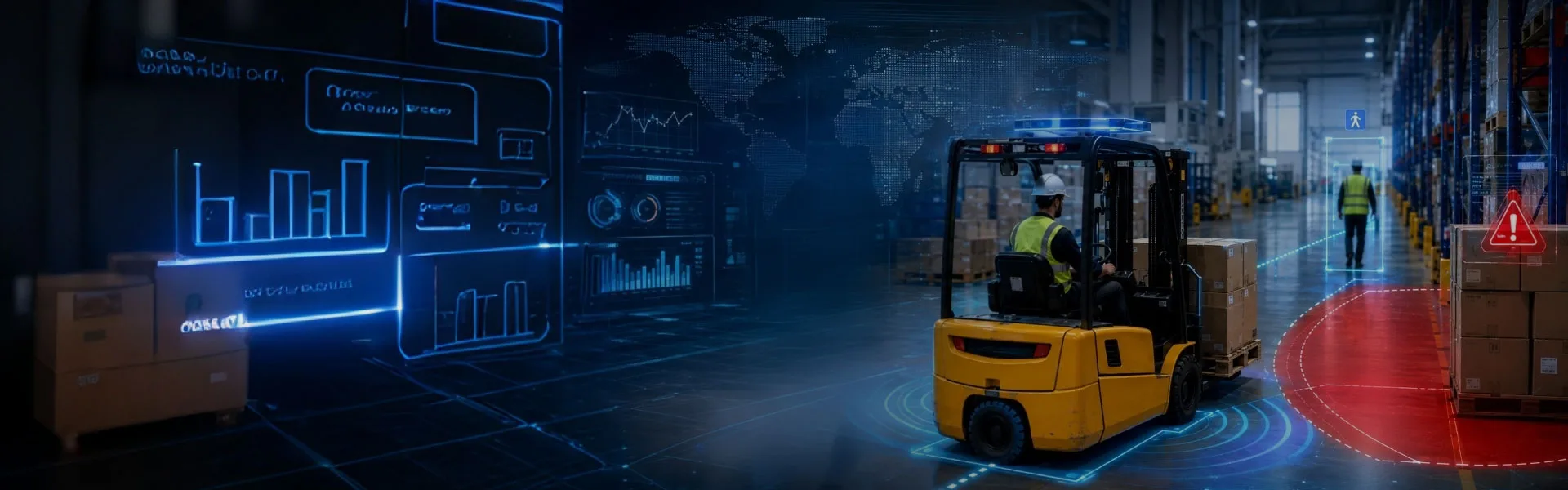
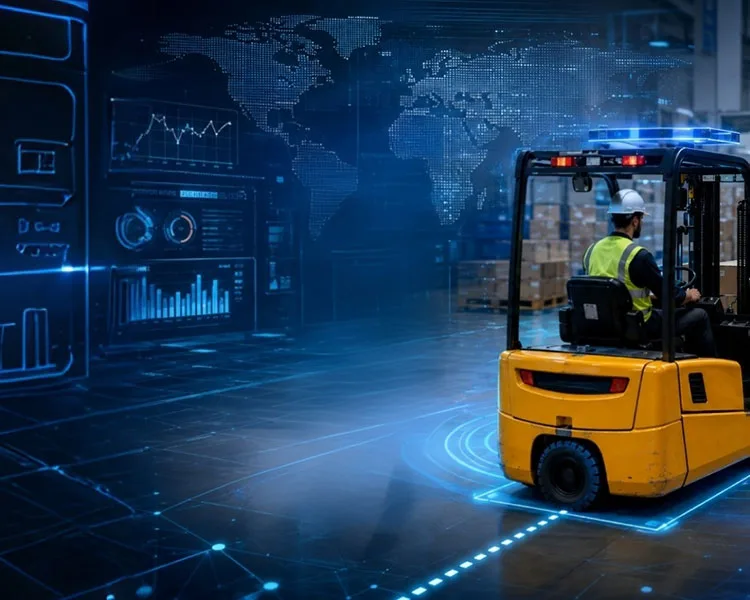
A successful forklift safety system installation begins before cameras, radar sensors, displays or warning devices are mounted on the vehicle. The first task is to understand the risks that the system must control, determine whether the forklift can support the required components and confirm that the proposed detection zones match real traffic conditions.
This matters because an electronic safety system can be correctly wired but still perform poorly in practice. A camera may be blocked by the mast or carried load. A radar sensor may detect racks or walls repeatedly. An alarm may be too quiet for the operating environment, while an overly large warning zone may generate so many alerts that drivers begin to ignore them.
The following checklist is designed for warehouses, factories, logistics centers and industrial sites preparing to install AI pedestrian-detection cameras, reversing radar, collision-warning devices or systems connected to vehicle speed control.
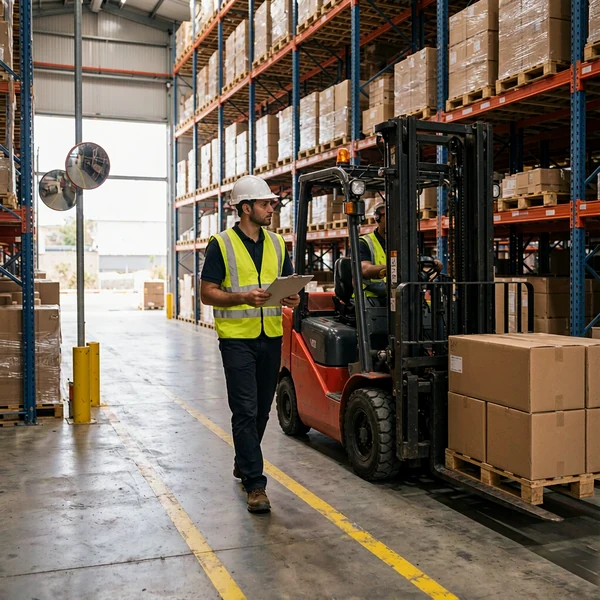
Do not begin with the question, “Which product should we install?” Begin with, “Which vehicle movement creates the risk, and under what operating conditions?”
A forklift may require rear pedestrian detection because most exposure occurs while reversing from racks. Another vehicle may need front and side coverage because it carries loads that obstruct the driver’s forward view. At a busy intersection, the main issue may not be visibility alone but the late appearance of pedestrians from behind walls, containers or storage racks.
Walk the vehicle route during normal operations and record where forklifts and pedestrians interact. Observe travel direction, vehicle speed, aisle width, turning behavior, loading activity and visibility changes. The assessment should include both frequent interactions and less common but potentially severe events.
| Site condition | Question to investigate | Possible system requirement |
| Reversing from racks | Can the driver see pedestrians approaching from either side? | Rear AI camera or reversing radar |
| Loads blocking forward visibility | How often does the driver travel with an obstructed view? | Front camera or additional detection coverage |
| Blind intersections | When does a pedestrian become visible to the driver? | Wider side coverage or fixed warning measures |
| Narrow aisles | Will racks or stored goods enter the detection zone? | More precise detection-zone configuration |
| Outdoor operation | Are rain, dust, glare or darkness common? | Suitable environmental protection and low-light performance |
| Mixed vehicle traffic | Must the system distinguish people from vehicles or static objects? | AI classification or combined sensing strategy |
| High-noise areas | Can the operator and pedestrians hear an alarm? | Visual warning, in-cab display or alternative alert method |
The result should be a defined safety objective, such as detecting pedestrians behind the forklift during reversing, warning the operator when a person enters a specified risk zone, or reducing vehicle speed when a critical condition is detected.
An AI camera, radar or warning device should support the site’s wider traffic controls. It should not replace pedestrian segregation, speed management, operator training, mirrors, barriers or safe operating procedures.
Before selecting components, record the forklift manufacturer, model, year, power type, rated voltage, vehicle dimensions and any existing attachments. The same safety system may require different brackets, converters, cable routes or control interfaces on different vehicles.
Electric forklifts deserve particular attention because the traction battery voltage may be substantially higher than the operating voltage accepted by cameras, displays and sensors. A suitable protected power supply or converter may therefore be required. Internal-combustion forklifts introduce different concerns, including vibration, heat and routing cables away from hot or moving components.
The mast, overhead guard, counterweight, load backrest and hydraulic components must also be reviewed. A convenient mounting point is not necessarily a suitable one if the mast, chains, hoses, attachments or carried goods can obstruct the detection area.
Where the installation may affect vehicle capacity, safe operation or the relative position of original components, obtain the appropriate approval before proceeding. For operations under US jurisdiction, OSHA 29 CFR 1910.178 states that modifications and additions affecting capacity or safe operation require prior written approval from the manufacturer, with relevant plates, tags or decals changed accordingly.
Local regulations and the forklift manufacturer’s requirements must also be checked because approval obligations vary by market and by the extent of the installation.
AI cameras and radar do not solve exactly the same problem. The correct choice depends on what must be detected, how accurately the system must classify the hazard and what environmental conditions are present.
| Evaluation factor | AI camera detection | Reversing radar |
| Primary function | Identifies visual targets such as pedestrians | Detects objects within configured areas |
| Target classification | Can distinguish people from many non-person objects, subject to system capability | Usually measures object presence, distance, direction or relative movement |
| Video evidence | Can provide live images and event recordings | Normally does not provide visual evidence by itself |
| Low-light operation | Depends on camera, illumination and installation position | Less dependent on ambient light |
| Dust, rain or visual contamination | Lens condition may affect performance | Can be useful in visually difficult environments, subject to sensor specification |
| Static structures | AI configuration may reduce alerts from irrelevant objects | Position and zone settings must prevent repeated rack or wall detection |
| Best fit | Pedestrian-focused detection, visual confirmation and event review | Reversing assistance and distance-based object warnings |
AI vision is generally more suitable when the safety objective is specifically to identify pedestrians and provide the driver with visual confirmation. Radar can be appropriate when the primary requirement is to detect an object behind a reversing forklift, including in lighting conditions that are challenging for cameras.
Some sites may benefit from combining the two technologies. That does not mean every vehicle needs every sensor. A combined configuration should only be used when the risk assessment shows that each technology addresses a distinct hazard.
Camera position should be tested with the forklift operating through its full range of movement before any permanent holes are drilled or brackets are fixed.
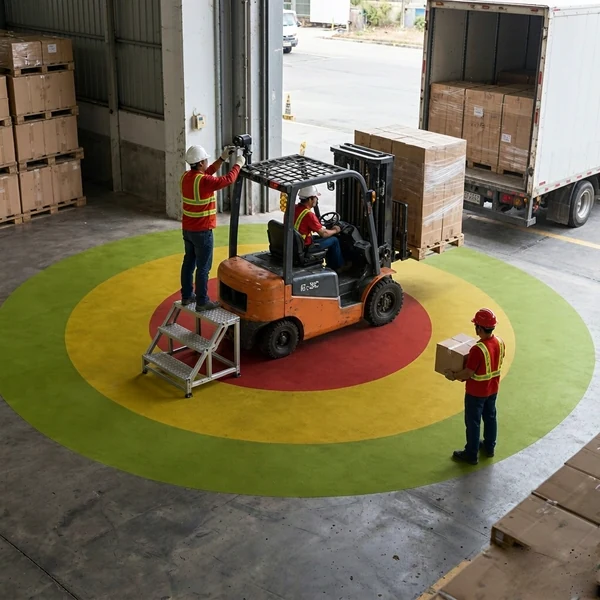
Temporarily position the camera and view the live image with the mast lowered, raised and tilted. Repeat the test with representative loads on the forks, during forward and reverse travel, and while the truck turns in both directions. The test should confirm whether the driver, mast, load backrest, hydraulic hoses or carried goods block any part of the required detection zone.
A wide-angle camera can cover a broad area, but the nominal viewing angle does not guarantee effective coverage after installation. The mounting height, camera tilt and shape of the forklift all influence how much of the ground-level hazard area remains visible.
Camera placement must also account for routine impacts, vibration, dirt, water and cleaning access. A protected position may extend equipment life, but the lens must remain accessible for inspection.
The UK Health and Safety Executive notes that CCTV performance can be affected by dirty lenses, changing light conditions and difficulty judging distance. Its guidance on safe vehicle manoeuvring also emphasizes that operators should be trained to use camera images without treating them as a complete replacement for direct observation and safe procedures.
For a vehicle-mounted AI system, conduct the test under the actual conditions found at the site: warehouse entrances, loading areas, bright outdoor yards, poorly lit aisles and areas with reflective surfaces. A camera that works well in one lighting condition may need repositioning or configuration changes elsewhere.
A reversing radar sensor needs a clear and stable mounting position with a detection path that corresponds to the forklift’s actual direction of travel.
Mounting too low may expose the sensor to frequent impacts or cause unwanted ground detection. Mounting too high may leave a gap close to the rear of the vehicle. The counterweight, body panels and attachments must not block the intended detection area.
The installer should test the proposed position against common background objects, including racks, dock edges, walls, doors, parked vehicles and stored materials. Radar coverage that extends beyond a narrow aisle may detect structures beside the forklift rather than hazards in its travel path.
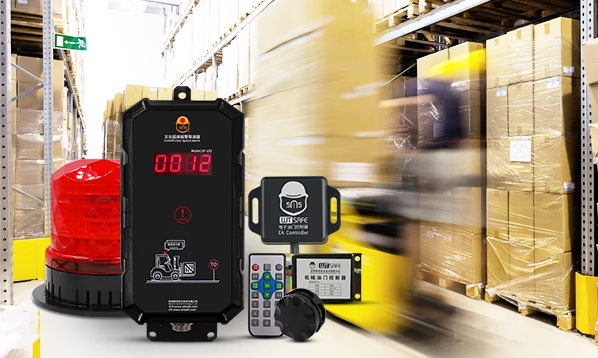
WTSAFE reversing radar configurations may support multiple warning zones, such as an outer warning area, a closer alert area and a critical braking area. The available range, number of targets and control functions depend on the selected configuration and vehicle integration. These values should be confirmed against the exact model before installation.
Do not set every zone to its maximum available distance by default. The correct distance depends on vehicle speed, operator reaction time, braking response, traffic density and the geometry of the work area. A large zone may provide earlier warning in an open yard but create excessive alarms in a narrow warehouse aisle.
Power and wiring should be designed as part of the installation rather than decided after the sensors have been positioned.
Confirm the forklift’s available supply voltage, ignition-controlled power options, current capacity, grounding method and protection requirements. Determine whether the system needs a voltage converter and whether power should be available only when the ignition is active.
Cable routes should avoid the mast, chains, lift mechanisms, hydraulic hoses, steering components, hot surfaces and locations where loads or operators may damage the wiring. Cables should have enough allowance for normal vehicle movement without becoming loose, pinched or stretched.
The operator display must be visible without blocking the driver’s normal view or creating a new impact hazard. Check screen glare, viewing angle and accessibility while the operator is seated in the normal driving position. Controls that require regular use should be reachable without encouraging the operator to look away from the travel path.
Audible and visual warnings must also suit the workplace. An alarm that is clear during a quiet installation test may be difficult to hear during production. Conversely, a loud external alarm activated too frequently may contribute to alarm fatigue among both drivers and pedestrians.
Detection and intervention are separate functions. A system may display a pedestrian, issue a warning, reduce vehicle speed or request an active braking response. Each level requires different validation.
For example, an outer zone may notify the driver that a pedestrian is approaching, while a closer zone produces a stronger warning. A critical zone may be connected to speed limitation or braking if the forklift, controller and installation configuration support that function.
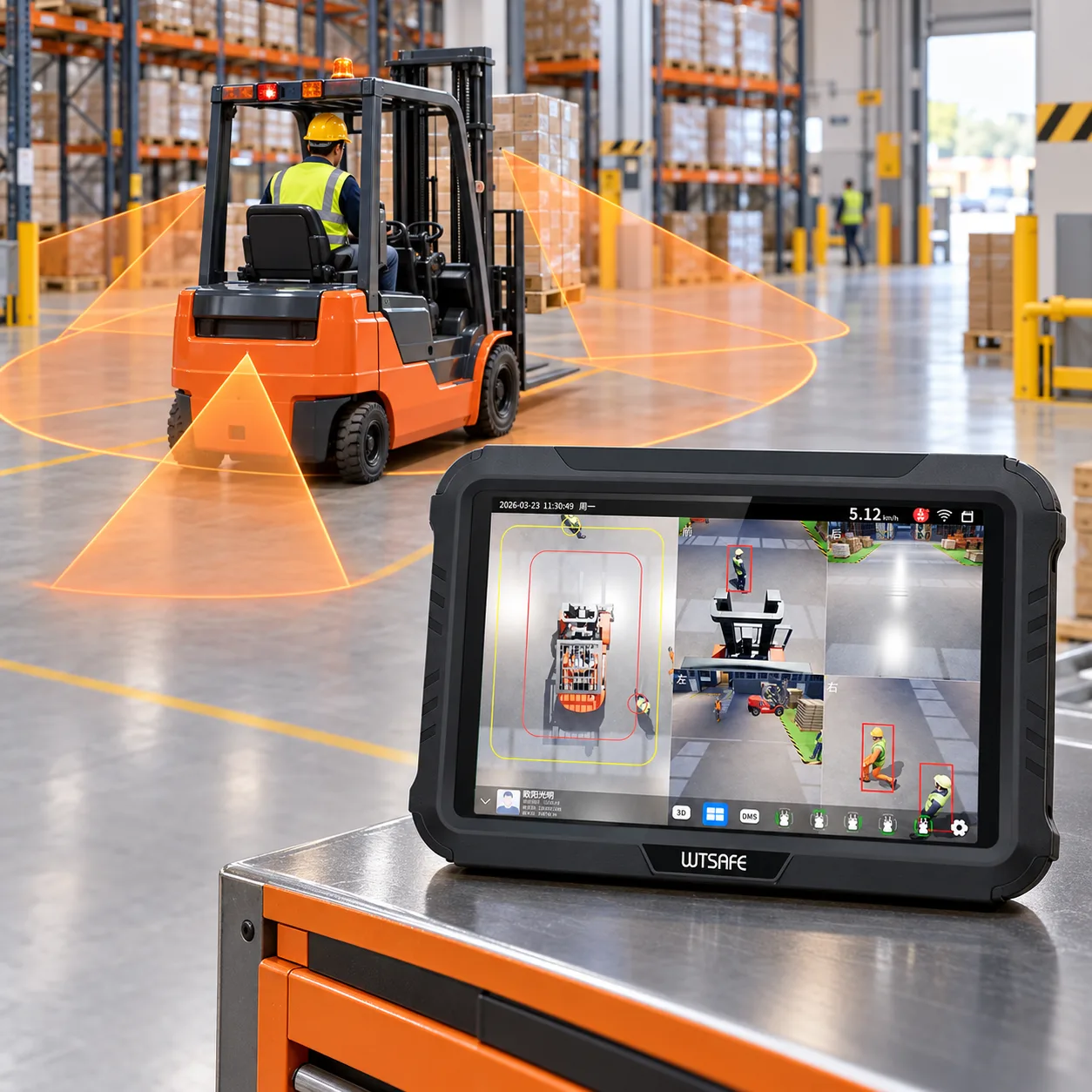
The WTSAFE SF-420 Pro AI Forklift Collision Avoidance System combines AI pedestrian detection with an in-cab display, audible and visual warnings, video-related functions and optional vehicle-control features according to the selected configuration. Its cameras and detection areas still need to be positioned and calibrated for the individual forklift and operating site.
Before enabling active intervention, confirm:
Active braking should not be treated as a universal plug-and-play feature. The stopping response depends on the forklift, speed, load, floor condition and integration method. Final settings therefore require controlled on-site validation.
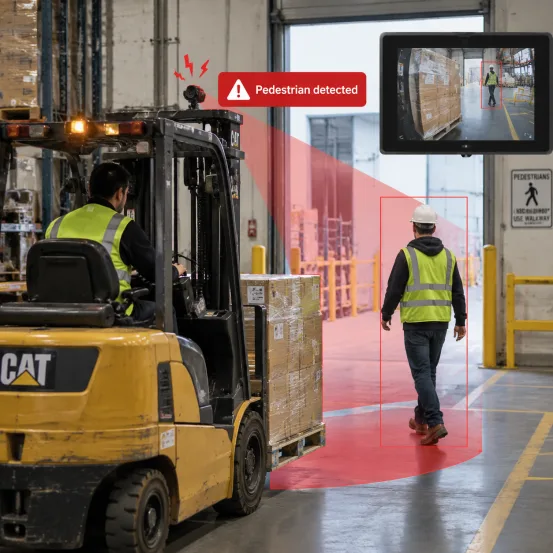
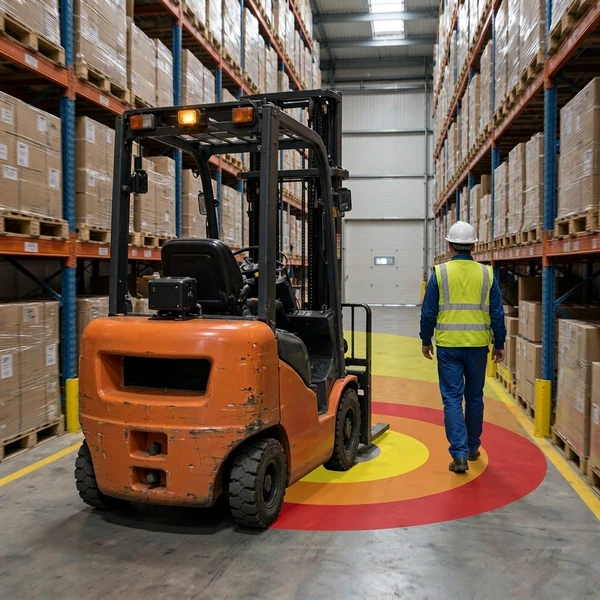
Here is the system at work: a pedestrian walks into the forklift’s danger zone, the AI camera picks them up and the driver gets a warning in the cab. What you see depends on the vehicle, the load and the site, so treat it as a live demonstration rather than a promise of the same stopping distance or system response.
AI pedestrian detection demonstration: the system identifies a person entering the configured forklift danger zone and warns the operator. Actual detection and intervention settings must be validated for each vehicle and site.
Commissioning is more than checking whether the screen turns on or the alarm sounds. The system must be tested against the hazards identified before installation.
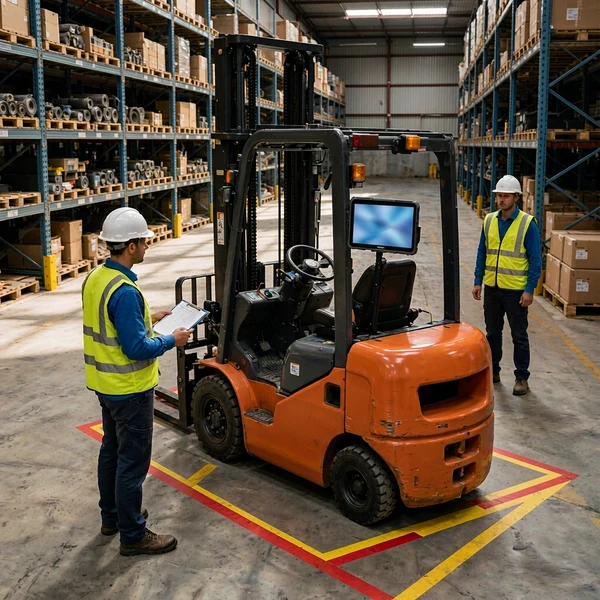
Use representative operating scenarios rather than a single stationary test. Test the forklift while reversing, turning, carrying typical loads and moving through both open and restricted areas. Include different pedestrian approaches, such as directly behind the vehicle, diagonally toward the travel path and emerging from behind an obstruction.
Testing should be conducted in a controlled area by authorized personnel. People should not be placed in an uncontrolled collision path merely to prove that detection or braking works.
| Validation item | Test condition | Acceptance question |
| Camera visibility | Mast raised, lowered and tilted; loaded and unloaded | Is the required area visible in every relevant state? |
| Pedestrian detection | Different approach angles and normal work clothing | Is the person detected inside the intended zone? |
| Nuisance alerts | Racks, walls, pallets and parked equipment | Are irrelevant warnings kept at an acceptable level? |
| Low-light performance | Dark aisles and indoor/outdoor transitions | Does detection remain reliable under site lighting? |
| Radar response | Objects at different distances and approach angles | Do warnings correspond to the configured zones? |
| Audible warning | Normal production noise | Can the intended person recognize the warning? |
| Display placement | Operator seated and travelling normally | Is the screen visible without obstructing the driving view? |
| Speed control or braking | Loaded and unloaded controlled tests | Is intervention predictable and suitable for the site? |
| Fault behavior | Simulated disconnection where authorized | Is the fault visible, and does the system fail in a defined manner? |
Record the final camera angles, sensor positions, warning-zone dimensions, software settings and test results. Photographs of the installed positions can make future maintenance and replacement more consistent.
Acceptance criteria should be agreed before testing. Otherwise, a system may be judged successful simply because it generated an alert, even if the alert occurred too late, too early or too frequently for the intended operation.
An effective system must detect meaningful hazards without warning the operator about every nearby object.
Frequent unnecessary alarms may occur when the detection zone includes racks, walls, loading doors, parked equipment or pedestrians who are physically separated from the forklift by a barrier. The first response should not be to disable the warning. Instead, review the sensor angle, mounting position, zone shape and trigger logic.
Observe where nuisance alerts occur and group them by location and operating condition. If most alerts happen in one narrow aisle, that area may need a different zone configuration from an open loading yard. If alerts occur during normal turning, the detection zone may extend too far beyond the vehicle’s travel path.
AI pedestrian classification can reduce alerts caused by some non-person objects, while radar zone adjustment can help prevent detection outside the relevant reversing corridor. Neither approach removes the need for on-site tuning.
The goal is not zero alarms. It is a warning pattern in which drivers can recognize and respond to genuine risk without becoming conditioned to ignore the system.
The installation is not complete when the vehicle returns to service. Operators and supervisors need to understand what the system detects, how warnings are presented and what the system cannot do.
Training should explain that the equipment is an additional safety aid. Drivers must continue to observe the direction of travel, follow speed limits, use designated routes and comply with site procedures. They should also know how to report a blocked camera, damaged sensor, loose cable, unreadable display or repeated false alert.
Add the installed components to the site’s inspection and maintenance process. A practical routine may include checking the camera lens, brackets, sensor surfaces, cables, display, audible warning and any visible fault indication. The interval should reflect the operating environment and the manufacturer’s instructions.
Retest the system after:
This change-control step is important because the original configuration was validated for a specific vehicle and site layout. A technically functioning system may no longer provide the same coverage after those conditions change.
Providing accurate vehicle and site information allows a supplier or installer to recommend a more appropriate configuration. Before requesting a quotation or technical proposal, prepare the following:
| Required information | Why it matters |
| Forklift manufacturer and model | Determines mounting and integration constraints |
| Vehicle year and power type | Helps identify electrical and interface requirements |
| Rated voltage | Determines power-supply or converter needs |
| Existing attachments | Reveals possible obstructions and approval requirements |
| Main travel direction and hazards | Defines required coverage |
| Photos of front, rear, sides and operator area | Supports preliminary position planning |
| Typical loads and maximum load dimensions | Shows how carried goods may block sensors |
| Indoor or outdoor use | Affects environmental and visibility requirements |
| Required detection targets | Clarifies whether pedestrian classification is necessary |
| Warning-only or vehicle intervention | Defines integration and validation scope |
| Typical travel speed | Supports warning-zone planning |
| Site layout or risk-area photos | Helps assess aisles, intersections and fixed obstacles |
A supplier should still verify critical conditions during installation. Photos and vehicle data improve preliminary planning but do not replace an on-site assessment and commissioning test.
A forklift safety system should only move to permanent installation after the team can answer four questions clearly:
When these questions are resolved before installation, AI cameras, radar sensors and collision-warning devices can be configured around the real vehicle and work environment rather than treated as generic accessories.
The next step is to collect the forklift model, voltage, site photos, typical load information and required warning or intervention functions. WTSAFE can then review the information and help define a suitable camera, radar, display and detection-zone configuration for further technical confirmation.